Every field test we support, grouped by category. For most trained runners, the Cooper 12-minute run or the 1.5-mile run are the most accurate. For non-runners, the Rockport walk or Åstrand cycle ergometer tests are the standard options. Non-exercise estimators are the least accurate but require no physical test.
The gold standard: lab CPET
The most accurate way to measure VO2 max is a cardiopulmonary exercise test (CPET) in a clinical or sports-medicine lab. You wear a mask connected to a metabolic cart that measures the exact volume and composition of every breath while running on a treadmill or cycling an ergometer at progressively harder intensities until exhaustion. The result is a direct measurement — not an estimate.
Cost
$200–$500 at most sports-medicine clinics and university exercise-physiology labs.
Duration
8–15 minutes of graded exercise, plus setup and recovery. ~45 minutes total visit.
Accuracy
Direct measurement — this is the benchmark. All field tests below are validated against it.
If you have access to a CPET, take it — nothing else comes close. But for most people, the cost and logistics make field tests the practical alternative. The tier list below shows how closely each field test correlates with a lab-measured result.
Accuracy tier list
How closely each method correlates with lab-measured VO2 max. Correlation values (r) are from the original validation studies.
Gold standard — direct measurement
Lab CPET with metabolic cart (r = 1.00)
High accuracy — r ≈ 0.87–0.92

Moderate accuracy — r ≈ 0.75–0.88

Low accuracy — r ≈ 0.50–0.75

| Test | Category | Equipment | Time | Accuracy |
|---|---|---|---|---|
| Cooper 12-Minute Run | run | Track or flat course | ~12 min | high |
| 1.5-Mile Run | run | Track or measured 1.5-mile route | ~15 min | high |
| 1-Mile Run | run | Track, heart rate monitor | ~10 min | high |
| 2.4 km Run | run | Track or measured 2.4 km route | ~15 min | high |
| Rockport 1-Mile Walk | walk | Track, heart rate monitor | ~15 min | moderate |
| 1.5-Mile Walk | walk | Track, heart rate monitor | ~22 min | moderate |
| Beep Test (20m Shuttle) | shuttle | 20m course, audio track | ~10 min | high |
| Yo-Yo Intermittent Recovery Test (Level 1) | shuttle | 20m course, audio track | ~15 min | moderate |
| Queen's College Step Test | step | 16.25" (41.3 cm) bench, metronome | ~3 min | moderate |
| Harvard Step Test | step | 20" (50 cm) bench, metronome, stopwatch | ~5 min | low |
| YMCA 3-Minute Step Test | step | 12" (30 cm) bench, metronome | ~3 min | moderate |
| Åstrand-Rhyming Cycle Ergometer | cycle | Cycle ergometer, heart rate monitor | ~6 min | moderate |
| YMCA Cycle Ergometer (Multistage) | cycle | Cycle ergometer, heart rate monitor | ~12 min | high |
| Resting Heart Rate Method | non-exercise | Heart rate monitor (or wrist pulse) | ~2 min | low |
| Non-Exercise Estimator | non-exercise | None | ~1 min | moderate |
| Bruce Treadmill Protocol | treadmill | Treadmill | ~15 min | high |
| 6-Minute Walk Test | walk | Flat 30m course, stopwatch | ~6 min | moderate |

Running tests

Cooper 12-Minute Run
highRun as far as possible in 12 minutes. VO2 max is estimated from total distance covered.
Track or flat course · ~12 min

1.5-Mile Run
highRun 1.5 miles as fast as possible. VO2 max is estimated from total time.
Track or measured 1.5-mile route · ~15 min

1-Mile Run
highRun 1 mile as fast as possible. Requires final heart rate. Best for fit college-age adults.
Track, heart rate monitor · ~10 min

2.4 km Run
highMetric equivalent of the 1.5-mile run (2.4 km ≈ 1.5 mi). Same formula applies.
Track or measured 2.4 km route · ~15 min
Walking tests

Rockport 1-Mile Walk
moderateWalk 1 mile as briskly as possible. Best option for lower fitness levels and older adults.
Track, heart rate monitor · ~15 min

1.5-Mile Walk
moderateWalk 1.5 miles as briskly as possible. Longer variant of Rockport; less validated.
Track, heart rate monitor · ~22 min

6-Minute Walk Test
moderateWalk as far as possible in 6 minutes. Common clinical test; distance predicts VO2 max.
Flat 30m course, stopwatch · ~6 min
Cycle ergometer tests

Åstrand-Rhyming Cycle Ergometer
moderateCycle at steady workload for 6 minutes. Predicts VO2 max from steady-state HR, workload, age, and sex.
Cycle ergometer, heart rate monitor · ~6 min
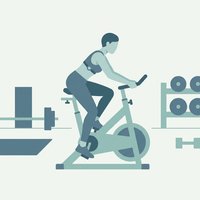
YMCA Cycle Ergometer (Multistage)
highTwo-stage submaximal cycle test. Linear extrapolation to age-predicted HRmax.
Cycle ergometer, heart rate monitor · ~12 min
Step tests

Queen's College Step Test
moderateStep on/off a 16.25" bench for 3 minutes at 24 (men) / 22 (women) steps/min. Recovery HR predicts VO2 max.
16.25" (41.3 cm) bench, metronome · ~3 min

Harvard Step Test
lowStep on/off a 20" bench at 30 steps/min for up to 5 minutes. Measures recovery HR at three intervals.
20" (50 cm) bench, metronome, stopwatch · ~5 min

YMCA 3-Minute Step Test
moderateStep on/off a 12" bench at 24 steps/min for 3 minutes. Recovery HR (1 min) maps to fitness category.
12" (30 cm) bench, metronome · ~3 min
Shuttle tests
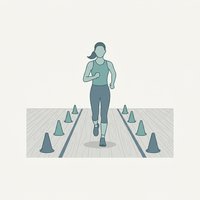
Beep Test (20m Shuttle)
highMulti-stage 20m shuttle run synchronized to audio beeps. Widely used for team sport athletes.
20m course, audio track · ~10 min

Yo-Yo Intermittent Recovery Test (Level 1)
moderate20m shuttles with 10s recovery. Designed for intermittent-sport athletes (soccer, basketball).
20m course, audio track · ~15 min
Treadmill protocols
No-exercise estimators
Which test should you pick?
- Runner, want the most accurate field result: Cooper 12-minute run or 1.5-mile run.
- Non-runner or older adult: Rockport 1-mile walk.
- Access to a cycle ergometer: Åstrand-Rhyming cycle test — best submaximal option.
- Team sport / shuttle context: Beep test (20m multi-stage) or Yo-Yo IR1.
- No test available, just want an estimate: Non-exercise estimator.